Rescue My Tech
Screens That Changed the World
📺A Love Letter to Television There was a time when the television was not just a screen, but a marvel. A glowing box that hummed softly in the corner of the living room, drawing families close and inviting the world inside. In its earliest form, it was crude. Mechanical parts spun behind curved glass, capturing shadows and light and translating them into a flickering image. Yet even then, there was magic. Even then, there was awe.
From those early mechanical systems of the 1920s to the heavy cathode-ray tubes that defined living rooms for half a century, the television has always been more than technology. It has been memory. It has been comfort. It has been connection. Some of us still remember turning dials on a black-and-white screen, waiting for the picture to stabilize, hoping the antenna wouldn’t betray us just as the theme song began. The screen wasn’t just a window—it was a ritual.
As color arrived, everything changed. The world looked different in red and green and blue. People saw parades and moonwalks, heartbreaks and miracles, all refracted through the soft tint of phosphor. The television became a witness. And with it, so did we.
There is something timeless about sitting still as a story plays out before you. We don’t think about the engineering behind it—the sweep of the electron beam, the chemistry of the display, the modulation of the signal. But it’s all there, behind the glass. Invisible, intricate, alive.
And then, everything got thinner.
The bulky sets that once dominated walls gave way to flat screens, then to LED and OLED, each version clearer, lighter, sharper than the last. We traded tubes for pixels, antennas for streams, and the weight of the past for the brilliance of now. Yet somehow, the soul of the screen remained. It still draws us in, even when the picture is perfect. Even when the story pauses to buffer.
In every home, the television reflects the life around it. It watches over families who still gather to share a film. It plays background to lonely nights and lively dinners, laughter and quiet. In children’s bedrooms and airport lounges, in kitchens and waiting rooms, it is always present. A quiet pulse of continuity in a world that keeps changing.
Now, our screens are smart. They know our preferences, connect to our lights, take our commands. With platforms like Tizen, WebOS, and Android TV, television is no longer passive. It adapts. It listens. It suggests. And yet the heartbeat is the same. It is still a screen that tries to bring us something. Something worth watching. Something worth feeling.
But not every story is about the new. The older sets still matter. The ones that hum softly, warm slowly, flicker quietly before they settle. They remind us of the days when patience was part of the experience. When changing the channel required movement. When static wasn’t a flaw, but a mood.
There is a strange beauty in that. And a purpose.
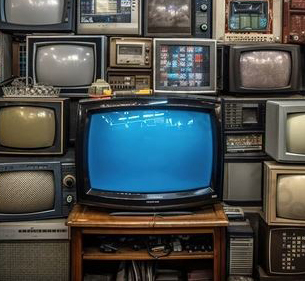
We preserve them not because they are efficient, but because they are meaningful. They are witnesses of a time when watching was an event, not just an option. The vintage consoles and rare tubes that sit in garages or basements or old shops deserve to be remembered. They remind us that the future wasn’t always crisp and flat and voice-controlled. Sometimes, it was grainy and glowing and filled with anticipation.
Even today, when we unbox a brand-new 4K display, mount it to a wall, and stream the latest story in Dolby Vision, we are still doing the same thing: watching the world unfold. The shape has changed. The experience has changed. But the ritual remains.
The television is not obsolete. It is simply transformed. It has survived format wars, media shifts, evolving tastes, and digital revolutions. And in every form—from the mechanical spinning disks of Baird’s experiments to the nearly invisible MicroLED panels—it carries something rare: endurance.
This is why we care. This is why we remember.
Because in the glow of a screen, whether modern or old, we still see ourselves. Our stories. Our silence. Our beginnings and our progress.
Television isn’t just a machine. It is a reflection. It is a presence. It is history, unfolding again and again in the soft light of a room that feels just a little more alive when the screen turns on.
Rescue the TV. Because some devices do more than display. They connect.
Let me know if you'd like a second version focused entirely on vintage TVs or if you want this adapted for a Tilda block.
From those early mechanical systems of the 1920s to the heavy cathode-ray tubes that defined living rooms for half a century, the television has always been more than technology. It has been memory. It has been comfort. It has been connection. Some of us still remember turning dials on a black-and-white screen, waiting for the picture to stabilize, hoping the antenna wouldn’t betray us just as the theme song began. The screen wasn’t just a window—it was a ritual.
As color arrived, everything changed. The world looked different in red and green and blue. People saw parades and moonwalks, heartbreaks and miracles, all refracted through the soft tint of phosphor. The television became a witness. And with it, so did we.
There is something timeless about sitting still as a story plays out before you. We don’t think about the engineering behind it—the sweep of the electron beam, the chemistry of the display, the modulation of the signal. But it’s all there, behind the glass. Invisible, intricate, alive.
And then, everything got thinner.
The bulky sets that once dominated walls gave way to flat screens, then to LED and OLED, each version clearer, lighter, sharper than the last. We traded tubes for pixels, antennas for streams, and the weight of the past for the brilliance of now. Yet somehow, the soul of the screen remained. It still draws us in, even when the picture is perfect. Even when the story pauses to buffer.
In every home, the television reflects the life around it. It watches over families who still gather to share a film. It plays background to lonely nights and lively dinners, laughter and quiet. In children’s bedrooms and airport lounges, in kitchens and waiting rooms, it is always present. A quiet pulse of continuity in a world that keeps changing.
Now, our screens are smart. They know our preferences, connect to our lights, take our commands. With platforms like Tizen, WebOS, and Android TV, television is no longer passive. It adapts. It listens. It suggests. And yet the heartbeat is the same. It is still a screen that tries to bring us something. Something worth watching. Something worth feeling.
But not every story is about the new. The older sets still matter. The ones that hum softly, warm slowly, flicker quietly before they settle. They remind us of the days when patience was part of the experience. When changing the channel required movement. When static wasn’t a flaw, but a mood.
There is a strange beauty in that. And a purpose.
We preserve them not because they are efficient, but because they are meaningful. They are witnesses of a time when watching was an event, not just an option. The vintage consoles and rare tubes that sit in garages or basements or old shops deserve to be remembered. They remind us that the future wasn’t always crisp and flat and voice-controlled. Sometimes, it was grainy and glowing and filled with anticipation.
Even today, when we unbox a brand-new 4K display, mount it to a wall, and stream the latest story in Dolby Vision, we are still doing the same thing: watching the world unfold. The shape has changed. The experience has changed. But the ritual remains.
The television is not obsolete. It is simply transformed. It has survived format wars, media shifts, evolving tastes, and digital revolutions. And in every form—from the mechanical spinning disks of Baird’s experiments to the nearly invisible MicroLED panels—it carries something rare: endurance.
This is why we care. This is why we remember.
Because in the glow of a screen, whether modern or old, we still see ourselves. Our stories. Our silence. Our beginnings and our progress.
Television isn’t just a machine. It is a reflection. It is a presence. It is history, unfolding again and again in the soft light of a room that feels just a little more alive when the screen turns on.
Rescue the TV. Because some devices do more than display. They connect.
Let me know if you'd like a second version focused entirely on vintage TVs or if you want this adapted for a Tilda block.
Explore more voices in the repair community:
Repair Nexus, TechMedic Pro, RepairSync, Device Doctors, Reset Rescue, FixFlow, Debug Depot, CodeMend, RestoreWorks, Digital Remedy
© Rescue My Tech. All rights reserved. Empowering your digital world, one device at a time.